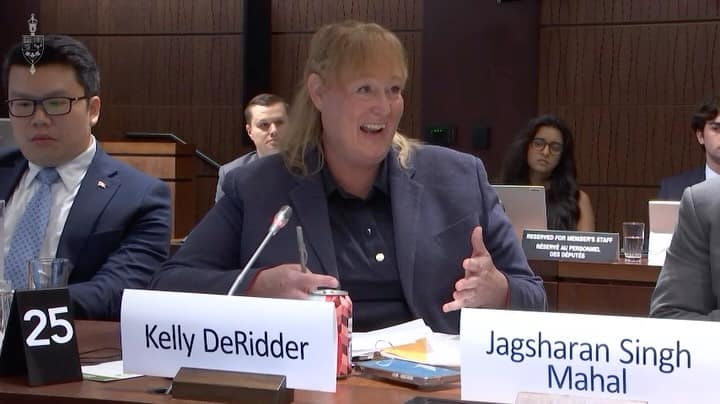
 Watch the video on Facebook
Kitchener Centre is Canada’s innovation capital.
Right here in Kitchener, companies are building dual-use technologies for civilian and defence applications, while others are already providing innovative products and services to the federal government.
The talent and technology are here. Now we need to make sure procurement is focused on Canadian innovation.
What Kelly says in this video
Automatic transcript; it may contain small errors.
Thank you everybody for coming today. Missile Born Kitchener Centre is Canada's innovation capital with many companies that are developing innovative technologies for both civilian and defence applications. Your survey you mentioned today identified almost 430 Canadian companies developing dual use technologies, yet few are supplying the Canadian government. Why is there such a significant gap between what Canadian firms are capable of providing and what government is actually procuring? Isn't that the big question we're all here to answer today? I think it's a number of things, obviously exposure to the Canadian government, just sort of understanding. There obviously is a new generational tone that we have not seen as a result of geopolitical tensions and this focus on Canada, just a reminder for all of the members in the room today, the council was founded 10 years ago by Jim Balsilly, so a veteran of the tech ecosystem in the region, but to answer your question more specifically, I think I'll maybe lean on my colleagues' comments earlier today, which I've written down here, we've been Canadian when no one was looking and we're at this new juncture of the economy where we really need to double down on our Canadian strategies, our plans, our investments and thinking those through. I don't think it's just enough to say let's put some money into a Canadian company to see how it grows and then if they have a sale globally, that's a single marker of success. There are so many organizations that have stepped up to the plate, we saw this during COVID and now we're seeing it again in the defence base and so on dual use I think it's particularly interesting because so many civilian applications can have military applications as well. Thank you. You've noted that many Canadian firms are finding greater success selling to foreign governments, I have a couple examples right in Kitcheners, Alchemy and Skywatch and the long term implications of that trend on Canadian sovereignty and industrial capacity and defence readiness, what is the implication going to be? We're not going to build our capacity here in Canada, we're not going to build our capabilities, we won't build our defence industrial base and I think that that is the antithesis of what we're trying to accomplish with the defence industrial strategy. Thank you. Mr. Yircha, your testimony today about innovation, ownership, IP, manufacturing and supply chain being Canadian, Canadian, Canadian from coast to coast to the host is incredibly impressive. You manufacture not only what we need but a really important way to keep our troops safe which is proper gear and you did mention in your testimony that you think the problem is with procurement. I agree, I think right now there's this narrative that's by Canadian but we're not really buying Canadian in a lot of sectors, yours included. I'm going to ask you a question that probably keeps you up at night, why do you think that the government is choosing to procure with like logistics unicorn owned by American private equity firm instead of a Canadian, Canadian, Canadian from coast to coast to coast company like your own? Great question, I think during this low power mode military time that preceded us here, I don't think that the folks really looked out and got into market much. We're seeing a huge ramp up right now but they only knew what was right in front of them and often that had to be in Ottawa, had to be in these hallways here and that's how they're known but it's so much more than that. We saw at CanSec, there's so many companies raising their hands right now and we've got to activate these different companies and we've got to get pen to paper. It took us six months to get the DIS out and we're still rolling it out but we've got to start getting these contracts out in a meaningful way for Canadian companies because they're all leaning forward right now and there's a runway. Thank you. I think I have time for one more question so I'm going to ask you Mr. Perry. Recently there was just a new AI document that came out by the Minister and have you in reviewing it, I'm sure CCI's reviewed it at this point, do you guys see a strategy or a plan that's going to get us to what this document says we're going to go? Thank you very much for the question. When it comes to the AI strategy we were task force members of the Minister's task force so we had very high expectations but also very strong recommendations like many Canadians we were looking forward to seeing what the document had entailed and when it came out to be quite frank with you it missed the mark I think when it comes to targets measuring what the strategy is looking to do that's what's missing in there with that said we were very eager to work with this government work with the opposition and work with everyone because at the end of the day when we do have a good AI strategy I'm going to have to stop you and I'm going to go to my liberal colleague Mr. Nour Mohammed for five minutes.