
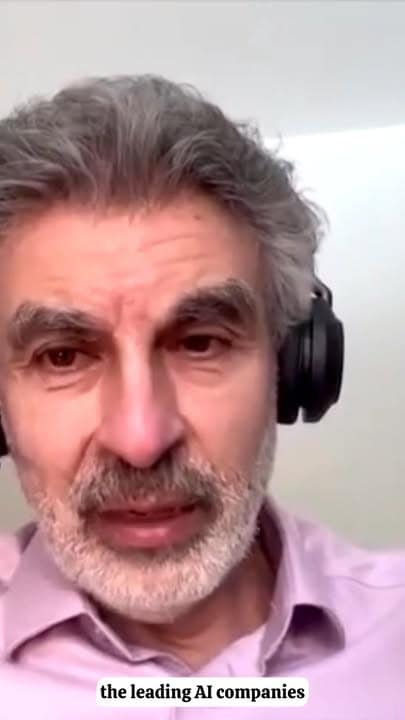
 Watch the video on Facebook
Specialty Al is a gamechanger when it comes to community planning, helping diagnose disease and in the Science & Research industries.
In Kitchener Centre, Canada's innovation capital, it is already powering new ideas and helping shape the future of our community.
What Kelly says in this video
Automatic transcript; it may contain small errors.
Hi, Dr. Benjio, thank you for joining us today. My questions will be for you. Much of your work rightly focuses on the risks and safety challenges of super intelligent AI. In places like my community of Kitchener Centre, Canada's innovation capital, we're seeing special TAI help people with brain injuries be better supported, diagnose disease, assist in civic planning and streamlining processes to drive real innovation, productivity, economic opportunity. Can you please explain the difference between special TAI in sectors like science and research, healthcare and industry, for example, and then super intelligent AI in which the developers even admit themselves they have no control over? Right. They're very different, as you're suggesting. There are even different methodologies. So AI isn't one thing. There's a large variety of methods and systems. Most of the AI approaches, for example, that are being used in research, in medical research, in scientific research in general, are not the same kind of AI as your chatbots that people are being used to now. And they are also different from what companies are planning and working on, which is the super intelligent AI's, which is supposed to be AI's that are smarter than all of us. But of course, so these are choices we can make. Right now, they are different. We could have AI that is safe and beneficial, that helps us to cure diseases and deal with all kinds of challenges we have without constructing machines that are dangerous by themselves. But because of the competition that exists between the leading AI companies, the competition that exists between China and the US, this is not happening right now. The race is towards super intelligence because there is a belief that it's going to give superpowers to whoever controls them, if they can control them, of course. Thank you for your answer. So essentially, specialty AI has a lot of economic opportunities for our country where super intelligent AI is the AI that we should be cautious about moving forward. Yes. With that being the case, do you believe specialty AI could be more of a tool in the toolbox of workers instead of a replacement for workers themselves? Exactly, exactly. It goes hand in hand with the idea that humans should remain at the center as we move in this economic transition. So there are two views of AI. One is it's a tool, and humans use the tool to be more productive and have a better life. And scientific researchers use it as a tool to improve and accelerate their advances. But the other view that is coming up, and if you interact with those chatbots, you're going to start feeling like, well, these are like people. And there are entities, and they have their own goals. And more and more studies shows that they somehow, because of the way they are trained, those chatbots, they acquire, they behave like people with their goals and self-interest and so on, even though we don't know what's really going on inside the box. But that's a choice that can be made, again, of what sort of AI we develop. And we don't need to rush into the things that are dangerous. We can steer, for example, the government could invest in AI that's more like a tool so that our companies and our people can benefit from it without creating crazy risks.