
 Watch the video on Facebook
In Kitchener Centre, Canada’s innovation capital, companies like Miovision are building world-class, AI-driven traffic technology that makes our intersections safer and more efficient.
Yet major projects are defaulting to foreign vendors, even when the right innovations exist right here in Kitchener. At a time when the U.S. is doubling down on “Buy America,” Canada should be just as intentional.
If we want economic resilience, security, and growth, we need to choose Canadian companies, choose Canadian talent, and choose Kitchener Centre.
What Kelly says in this video
Automatic transcript; it may contain small errors.
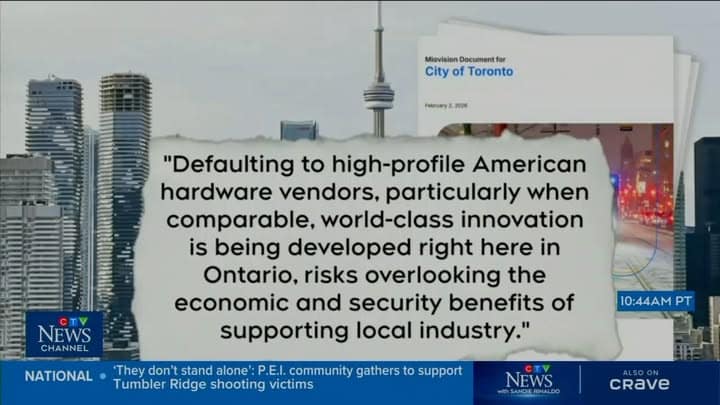
Traffic signals for a Toronto rail line is being conducted by a U.S.-based company, a move that is raised in questions about why an Ontario-based tech firm didn't get the gig. CTV's Natalie Johnson reports. This is a testing rack that we have. So all these blinking lights that you see over here, these are the units that would go inside of the traffic cabinet. Inside Myovision's massive high-tech hub. These are products that would go into an intersection and would help cities to understand and optimize traffic flow. The Kitchener-based tech company is producing products that transform traditional traffic lights into data-driven networks. We want to make sure this thing works in Alaska winters and Phoenix summers. So we'll take it really cold, and then you can see that guy's at 75 degrees right now. We take it really hot. These smart systems connect to cameras to read the flow of traffic at intersections, optimizing signal timing to combat congestion. There's North America. With the technology already installed in 130 Toronto intersections, 20,000 worldwide, Myovision had expected to bid on the transit signal priority project for the Finch West LRT, which recently launched at lagging speeds, often held up at red lights. Fixing traffic is what we do. So not only can we preserve manufacturing jobs in Ontario, but we can also enhance the traffic and the driving experience for all the citizens. But when the procurement call for analytic systems at eight intersections along the Finch West corridor came out, the city's RFP specified the name of a U.S.-based company. Myovision writing to the city in protest, quote, defaulting to high-profile American hardware vendors, particularly when comparable world-class innovation is being developed right here in Ontario, risks overlooking the economic and security benefits of supporting local industry. Toronto is in our backyard, has been one of our first customers, and we feel right now a bit betrayed by our own country. The city called it a mistake and removed the company name, but continued to ask for the specific LiDAR laser technology used by that same American firm. As the trade war with the U.S. continues, a new Build America by America policy comes into effect in the states later this year, requiring 55% of the cost of a manufactured good to be born in the U.S. That puts pressure on Canadian companies like Myovision to grow demand here to offset the losses that will come south of the border. With so much economic uncertainty, governments at all levels need to be prioritizing investment in Canadian companies. In this instance, we have one of the world-leading traffic AI technology companies right here, and through the procurement system here at City Hall, they were effectively excluded. The city telling CTV News in a statement, quote, while Myovision's video-based analytics have been used successfully in the city, Myovision does not offer the LiDAR-based technology the city is exploring through this work assignment. If I'm a citizen and I'm driving around, what I care about is, is it safe and is it quick, right? Like, can I get there when I want to get there? What technology you use to give me that outcome, I don't really care. I want the best possible price and the best possible outcome for me and my family. Myovision feeling frozen out of a Canadian contract at a time when governments have pledged to boost domestic demand by giving companies here at home the green light. Natalie Johnson, CTV News.