Your MP at Work

Kelly DeRidder on Advocacy for Kitchener Centre in the House of Commons

This page collects Kelly DeRidder's work in Ottawa on behalf of Kitchener Centre. It includes speeches in the House of Commons, letters to ministers, and posts about her meetings and events at home.

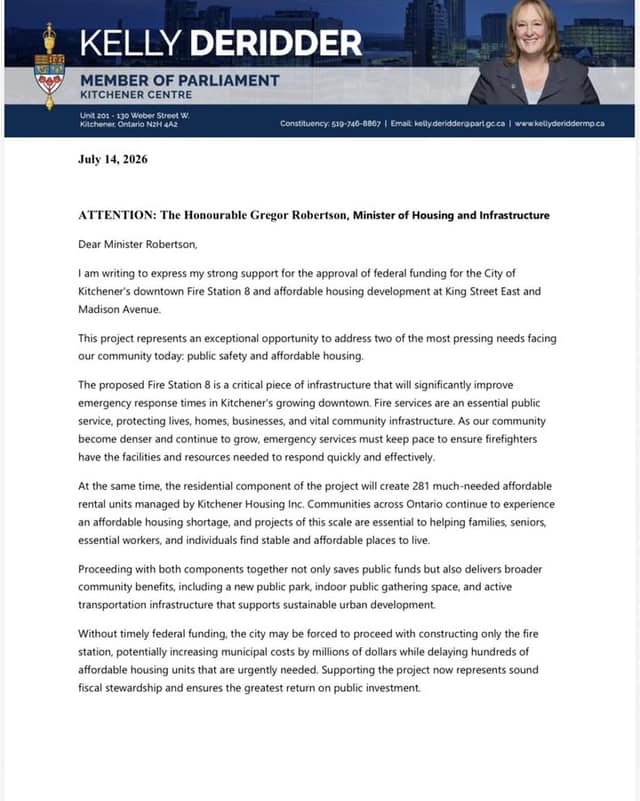
Housing is a clear focus. Kelly has written to the federal government in support of Kitchener's Fire Station 8 project, which would create 281 affordable homes and build them together with emergency services. She has also spoken about barrier-free homes for people with disabilities, and about prevention and recovery as ways to address youth homelessness. Her Private Member's Bill C-240 supports abstinence-based recovery, and it passed second reading in the House of Commons unanimously.

You will also see her work on local jobs and community concerns. She has highlighted Kitchener's innovation sector and the need for Canadian companies to be part of federal procurement. She hosted a CUSMA roundtable on trade and held a town hall on social media legislation at Doon Pioneer Park Community Centre. She also sponsored a petition on local journalism after 570 NewsRadio ended broadcasting, and she met with Camino Wellbeing + Mental Health about its Path to Education program.

233 posts, videos and speeches.

Facebook · July 28, 2026

Canada has the talent, developers, and ability to build world-class technology. True digital sovereignty requires control over our own infrastructure and data. If we rely on foreign cloud providers and laws, we aren’t truly in control of our digital future.

Facebook · July 28, 2026

📱Join us for a Town Hall discussion with MPs Connie Cody and Dr. Matt Strauss on the federal social media ban and what it means for Canadians. Come share your thoughts, ask questions, and be part of the conversation about the future of online access and digital freedoms.

Facebook · July 25, 2026

Addiction should never be a life sentence. My Private Member’s Bill C-240 supports abstinence-based recovery, giving offenders the opportunity to overcome addiction, restore their lives, and reduce the cycle of crime. Recovery works.

Facebook · July 20, 2026

Reminder! Join us for our CUSMA Roundtable to discuss the future of trade, tariffs, and what they mean for our local economy. We'd love to have you be part of the conversation - RSVP by emailing [email protected].

Facebook · July 20, 2026

I’ve been ensuring that Canadian companies are part of the supply chain when it comes to international procurement, I will be watching and paying close attention to if our Canadian companies will be part of the new contracts, supply chain eco system.

Facebook · July 20, 2026

I've written to the Minister of Housing urging approval of federal funding for Kitchener's Fire Station 8 and affordable housing project. This investment would strengthen emergency services, create 281 affordable homes, and save taxpayers millions by building both together.

Facebook · July 17, 2026

Local radio matters. It’s where communities hear their stories, local news, and emergency updates. If you oppose the shutdown of local radio stations, add your name to our petition. Sign up through the link in bio.

Facebook · July 11, 2026

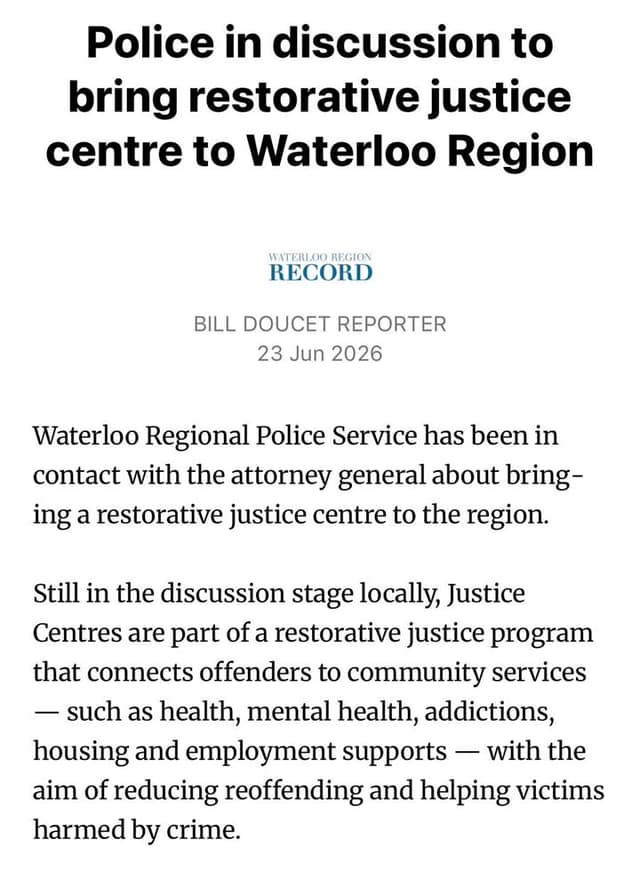
Breaking the cycle of crime means investing in accountability, healing, and rehabilitation. A restorative justice centre in Waterloo Region could help change lives, and the passage of Bill C-229 would be an important step toward making initiatives like this possible.

Facebook · July 10, 2026

Local journalism makes for a healthy democracy. I'm proud to be the sponsor of this petition calling on the government to take action. If you believe it's time for Ottawa to listen and deliver real results, add your name today. Sign the petition here: https://www.ourcommons.ca/… Read more

petitions/en/Petition/Details?Petition=e-7574

Facebook · July 8, 2026

Local journalism matters. Canadians deserve answers. Waterloo Region lost an essential platform for local journalism yesterday when Rogers abruptly ended broadcasting at 570 NewsRadio. My thoughts are with the employees and their families who are directly affected. This move al… Read more

so raises immediate concerns about the future of Kitchener Rangers radio coverage and whether those broadcasts will find a new home. Rogers Communications continues to benefit from substantial federal support, including: - Millions in taxpayer-funded programs intended to protect jobs and sustain local journalism; - A telecom environment shaped by federal policy that limits competition and shields major players from new market entrants. Despite these advantages, and despite commitments to preserve local media, Rogers has chosen to close stations anyway. This underscores how the current federal government’s strategy for safeguarding local news and employment is simply not working. After approving the Rogers-Shaw merger, Former Industry Minister and now Finance Minister François-Philippe Champagne promised to ‘watch Rogers like a hawk,’ insisting the merger would benefit consumers. Yet here in Kitchener, workers have lost their jobs and residents have lost a vital source of community news. Conservatives stand for protecting jobs, ensuring fair treatment for consumers and taxpayers, and strengthening local journalism. Canadians deserve more opportunities to have their stories told, not fewer. Local journalism is instrumental in a healthy democratic society. The current federal government must explain how its extensive support for Rogers is serving Canadians.

Facebook · July 7, 2026

Your voice matters. Are you and your business affected? Join us for a CUSMA Roundtable to discuss the future of trade with the U.S. and Mexico. Email for details.

Facebook · July 2, 2026

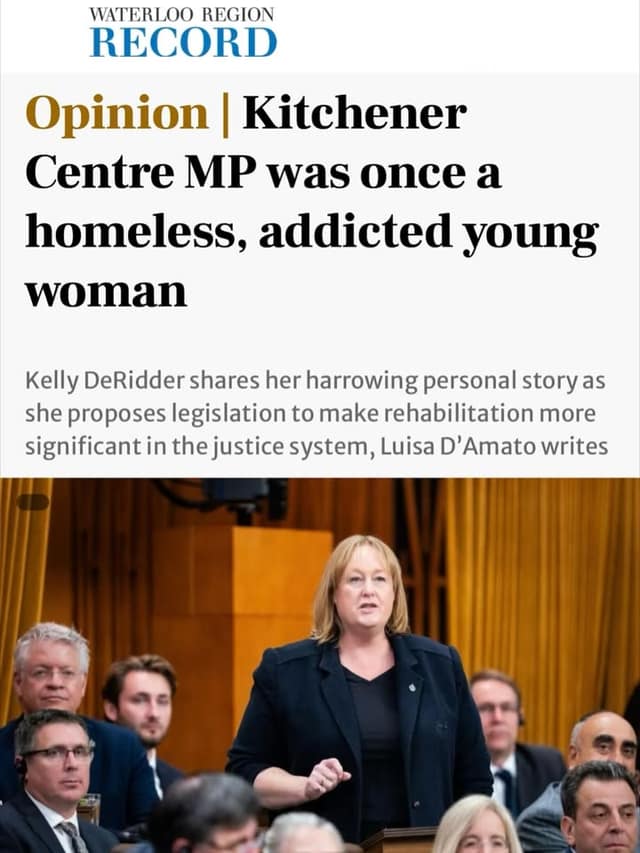
My story is not unique. Across Canada, there are people battling addiction who need support, accountability, and a path forward. That’s why I introduced Bill C-240, which would expand rehabilitation opportunities and help break the cycle of addiction and crime.

Facebook · June 30, 2026

It is an honour to be appointed as the Shadow Minister for Women and Gender Equality. In this new role, I will continue advocating for policies that support women, strengthen families, protect those most vulnerable, and ensure every Canadian has the opportunity to succeed. I lo… Read more

ok forward to bringing the voices of Kitchener Centre to this important portfolio and continuing to serve as a strong voice for our community in Ottawa.

Facebook · June 29, 2026

WATCH! We are here for victims of crime, for public safety, and for justice. That’s why we continue to oppose the removal of mandatory minimum sentences for serious offences.

Facebook · June 26, 2026

Over the past week, I’ve been able to reflect on everything that happened this session. From standing up for taxpayers and pushing for affordability to meeting with residents and local organizations across Kitchener Centre, it’s been a busy and productive few months!

Facebook · June 18, 2026

MOTION ON NOTICE Addiction should not be a life sentence. The status quo is failing. People are dying. Encampments are growing. Families are watching loved ones disappear into addiction. We don’t need more money spent managing addiction. We need existing funds redirected tow… Read more

ard treatment, recovery, and helping people rebuild their lives.

House of Commons · June 18, 2026

House of Commons

Thank you. Mr. Gladstone, I want to ask you a quick question. You mentioned the need for a carve-out from Build Canada Homes for people with disabilities. I agree completely. I just learned about what true barrier-free is for those with disabilities. What portion of that do you… Read more

think is required to ensure that they're supported through the Build Canada Homes program?

House of Commons · June 18, 2026

House of Commons

Thank you, Chair. Before I ask a couple of questions, I'd like to put a motion on notice for the committee. It reads: That, given that: homelessness, addiction and mental health challenges continue to have significant impacts on individuals, families and communities across … Read more

Canada; communities across the country continue to experience rising homelessness, ongoing substance use harms and increasing pressure on frontline services; the current approaches have not delivered the outcomes Canadians deserve; Canadians are demanding a renewed focus on prevention, early intervention, treatment, recovery, housing stability and community reintegration, with measurable outcomes that help individuals achieve long-term health, stability and independence; and it is important that federal investments support measurable outcomes, accountability and access to services that help Canadians achieve long-term recovery, stability and independence; the committee report to the House its recommendation that the Government of Canada: evaluate whether current approaches are achieving their intended outcomes and prioritize investments that demonstrate measurable results in treatment, recovery, housing stability, and long-term independence; and administer existing federal initiatives and funding commitments in a way that prioritizes: stronger access to treatment, recovery and mental health supports; expanded access to stable housing options, including transitional and supportive housing where appropriate; prevention and early interventions that reduce the risk of homelessness and substance use harms; measurable outcomes, accountability and long-term support for individuals seeking stability, recovery and independence; and collaboration among federal, provincial, territorial, municipal, indigenous and community partners to improve outcomes for Canadians affected by homelessness, addiction and related social challenges. Thank you, Chair.

Facebook · June 16, 2026

Addiction and homelessness are not moral failures. The Kitchener encampment ruling highlighted a difficult reality: we don’t have enough housing or recovery services. It’s time to invest more in treatment and recovery, and less in managing addiction indefinitely.

House of Commons · June 11, 2026

House of Commons: Oral Questions — Seniors

Mr. Speaker, that was another non-answer. The Liberal government has said that it is going to make life affordable for everyday Canadians. If this is true, can the minister please stand up and explain why seniors make up the fastest-growing group in the Waterloo region facing ho… Read more

melessness? The wait-list for individuals over 55 needing affordable homes in the region has increased by 700%.

House of Commons · June 11, 2026

House of Commons

Thank you, Chair. Thank you, everybody, for coming today. Ms. O'Born, Kitchener Centre is Canada's innovation capital, with many companies that are developing innovative technologies for both civilian and defence applications. The survey you mentioned today identified almost … Read more

430 Canadian companies developing dual-use technologies, yet few are supplying the Canadian government. Why is there such a significant gap between what Canadian firms are capable of providing and what government is actually procuring?

House of Commons · June 11, 2026

House of Commons

Thank you. You've noted that many Canadian firms are finding greater success selling to foreign governments. I have a couple of examples. Right in Kitchener are Alchemy and SkyWatch. What are the long-term implications of that trend going to be for Canadian sovereignty, industr… Read more

ial capacity and defence readiness?

House of Commons · June 9, 2026

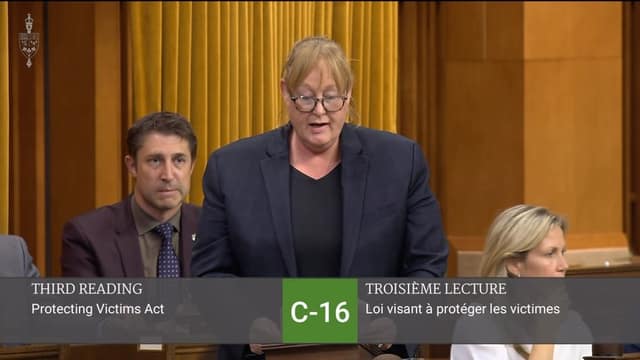
House of Commons: Government Orders — Protecting Victims Act

Mr. Speaker, I will be splitting my time with the member for Hamilton East—Stoney Creek. I rise today to speak to Bill C-16, the protecting victims act. The name of this bill sets a high standard. Protecting victims is the single most important part of any justice system. Canad… Read more

ians rightfully expect a system that supports those who have been harmed, protects the vulnerable and holds offenders accountable for their actions. Bill C-16 attempts to address a number of serious issues, including intimate partner violence, sexual exploitation, sexual violence, victims' rights and delays in our justice system. That expectation has not always been met in our justice system. Too often, victims feel like an afterthought. Too often, families are left waiting for justice. Too often, Canadians are left to wonder whether our justice system is putting the rights of offenders ahead of the safety of communities. Many Canadians saw that in a recent case in Kitchener, where a former neurologist was acquitted on 48 sexual assault charges. Dozens of victims gathered the courage to come forward and share their stories, and the justice system left them feeling unheard and brushed aside. We can agree in this place that it takes a tremendous amount of courage for a victim to come forward with their experience. When they do, it is important that we treat them with dignity, listen to their concerns and ensure that their voices are heard. That is why, when legislation like this comes forward, we must hold it to a high standard. There are parts of this bill that would be steps in the right direction. One of the biggest changes would be the creation of a new offence relating to coercive and controlling behaviours in intimate partner relationships. Many people think that the abuse begins when someone is physically assaulted, but it often starts long before that. It starts with manipulation, isolation and threats. It starts with controlling where a person goes, who they see, who they spend their time with, what they spend their money on or how they live their daily lives. These behaviours slowly chip away at one's independence and leave people feeling trapped in dangerous situations. By the time physical violence occurs, the warning signs may have been there for months, sometimes even years. Recognizing those warning signs in law is an important step. If interventions can come earlier, lives may be protected and future violence may be prevented. Another story from my riding is of a woman who was strangled by her husband in front of their daughter. Today, she and her daughter are living in a domestic violence shelter, trying to rebuild their lives and find safety, yet despite a guilty plea, the man responsible remains here in Canada illegally. When victims and their families are left in situations like this, they are left asking simple questions: Where is the accountability? That is why getting legislation like Bill C-16 is incredibly important. Victims need more than words. They need to know that the justice system will protect them, support them and hold offenders accountable for the harm that they have caused. This bill also includes measures aimed at combatting child exploitation. This, especially, is an area where Parliament should be united. Technology has created incredible opportunities but also real dangers. For all the parents in this place, we can agree that we are raising children in a world that looks very different from the one we grew up in. Predators can reach children so easily through social media, phones, computers and gaming platforms. These threats are real and our children need to be protected. This bill would also update the law surrounding intimate images and digitally altered sexual images. Whether an image is captured with a camera or generated with AI, the impact to victims is devastating. Reputations can be destroyed. Careers can be damaged. Mental health can suffer, and relationships can be affected. Victims deserve protection regardless of how that image was created. For many victims, navigating the justice system can be overwhelming while they are already dealing with the trauma that it has caused. They may not understand what is happening with their case or how decisions are being made. They may feel lost in a process that can seem focused on everyone except the victim. That needs to change. Victims deserve information and respect, and they deserve to know that they matter. The Conservatives have worked constructively on this bill. We supported measures that would better protect victims, address cohesive control, combat child exploitation and strengthen victims' rights. However, despite these positive measures, the bill also includes a major change to sentencing that deserves attention. The government says this change is about flexibility and discretion, but Canadians deserve to understand what it would actually do. This bill would allow a judge to bypass every mandatory minimum sentence in the Criminal Code, with a few exceptions. In other words, it would make mandatory sentences optional, and “mandatory” is not supposed to be optional. Why does this matter? It matters because mandatory minimum sentences exist for the most serious crimes. They represent the basis that certain crimes are so serious that there must be a minimum consequence when someone is convicted. It cannot be a suggestion. If a crime carries a mandatory minimum sentence, Canadians expect that to mean consistency and accountability across the board. There is no room for victims to wonder if the punishment will fit the crime. If mandatory sentences become optional, confidence in our justice system would be weakened even further. That is why the issue deserves serious attention. Our justice system already contains flexibility. Police officers use discretion when determining whether or not charges should be laid. Crown prosecutors exercise discretion when determining how cases should proceed. Prosecutors make decisions every day about what charges to pursue and what position to take before the court. When Parliament created a mandatory minimum sentence, it did so because Canadians expect a certain level of accountability for a serious crime, and we did not do that by accident. Canadians may disagree on what that line should be, but they understand that there should be a line. What they do not understand is why Parliament would establish a line and then create a way around it. I hear a lot of frustration from people in Kitchener Centre, and, frankly, from people across the country, about what feels like a growing gap between what the justice system says and what it actually does. People hear that a crime carries a mandatory minimum sentence, but then they find out that the sentence might not actually be mandatory. They hear that victims are the priority, but then they watch victims spend years navigating a system that feels confusing and overwhelming. They hear that public safety comes first, but then they read stories about repeat offenders just cycling through the justice system again and again. Whether those perceptions are fair or not, they are real, and public confidence matters. Our justice system depends on trust. People need to believe that the rules are applied fairly, that serious crimes are treated seriously and that victims matter, full stop. That is especially important when we are talking about crimes that leave lasting scars on victims, families and entire communities. The effects of violence do not end when a court case concludes. Victims carry those experiences for years. Children carry them for a lifetime. Families carry them for a lifetime. Anyone who has sat across from a victim of violence knows that the impact reaches far beyond the courtroom. Accountability matters, not because accountability can undo the harm it caused. It cannot. Accountability matters because it tells victims that society recognizes the seriousness of what happened to them, and it tells them their suffering matters. Canadians are increasingly concerned about public safety. Repeat offenders cycle through the system, and victims struggle to get justice, so why would we yet again weaken the consequences for offenders, while victims try to rebuild their life? Let us think about that. While victims are left traumatized, Parliament would create another pathway for offenders to avoid consequence. That is not what Canadians think of when they hear the words “protecting victims act”. Canadians want accountability. They want consequences. They want confidence that when Parliament says a sentence is mandatory, it actually means that it is mandatory. We want a justice system that protects victims while holding offenders accountable. I would like my community to know that I am not voting against protecting victims of intimate partner violence. I am not voting against protecting victims of child exploitation. I am not voting against victims of sexual violence. I am not voting against protecting victims' rights within delays in the justice system. What I am voting against is making mandatory minimums optional: clause 63. When it is eventually spun that I voted against protecting victims, please remember that I voted to ensure that victims are actually protected by ensuring that mandatory minimums remain, not as an option.

House of Commons · June 8, 2026

House of Commons

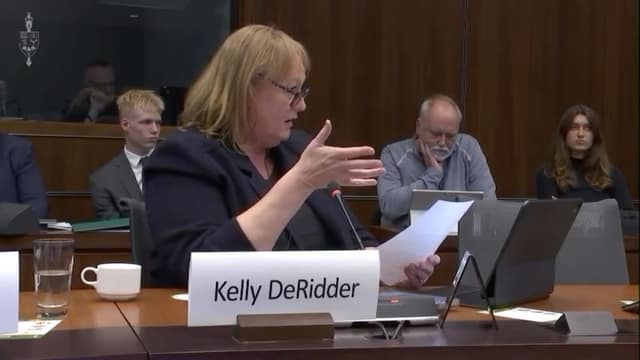
I'll be sure to look at it because I want to read through it myself. Thank you. You also mentioned that we don't have a lot of pharmaceutical companies in Canada, and you'd love to see more. I think really great examples for ensuring that we retain our IP in Canada do come out … Read more

of the pharmaceutical world. For example, penicillin and Ozempic were both Canadian inventions, but we didn't retain the IP and didn't see the economic impact. I appreciate my colleagues' questions, as well, about Canadians being unsure of AI and what the future holds. IP retention, in the future, is a very critical component to ensure that we see the economic impact of AI and digital innovation moving forward. Do you see a strong strategy and plan, right now, from the scientific standpoint, to ensure that our universities and researchers are educating our entrepreneurs and developers on the importance of IP retention for Canadian economic impact?

Help Kelly keep working for Kitchener Centre

Kelly's work in Ottawa is backed by volunteers and supporters here at home. A monthly donation of any size keeps the local team going, and political contributions earn a generous federal tax credit.